
#274. Hip dips dissed

Welcome to the NRP. We are curating the “New Right” discourse. It’s like a magazine with the best right-wing commentary from around the web: The most interesting threads and essays, spiciest podcast episodes, hilarious tweets, memes and more, thoughtfully curated and delivered to your inbox every week.
💬Discourse of the Week 💬
> Guys are teasing girls about their pig disgusting hip dips in an attempt to invert their treatment at the hands of malicious foids who insist on at least 6 feet, 6 figures, and 6 inches. The gals are not taking it well.
🧵Threads of the Week 🧵
> Cyberpunk’s never going to happen.
The downtrodden underclass are never going to become super high agency computer wiz genius street samurai warriors, hacking into corpo supercomputers and committing acts of terrorism against THE MAN. They’re actually just going to be fat degen gooners and addicts, outsourcing all cognitive function (and gambling action) to machines, eating kool-aid pineapple and sharing AI videos of African kids doing autobody work with brick and mortar.
> Devon Eriksen responds to a snarky Euroid with the story of his wife’s brain tumor treatment in the U.S., which wasn’t too shabby, all things considered.
Were she and I British, living in Britain, relying on the National Health Service, I would be a widower now.
Did saving her cost a ruinous amount of money?
Yes. This technology was expensive to create, and the people who did so deserve to pay their mortgages and feed their kids. So do the oncologists and surgeons.
Many of the men who cared for her were old men, experienced men, long past retirement age, still working because when your profession is clawing souls back from the void, sitting on a beach with a pina colada instead just doesn’t hit the same.
They deserve every cent.
> For being such high-information media literates, elite human capital sure does seem to fall for every cheap conspiracy theory.
Something that isnt talked about nearly enough, mainly because it goes against Hanania’s whole thing, is the total collapse of the left wing information ecosystem since the 2024 election into conspiracism and extremist content.
> Hypergamy can be good, says Zero HP Lovecraft.
When young women choose their own mates, you get Africa.
When old women choose the mates of their daughters, you get India.
When young women choose their own mates in a place where men brutally police each other for honesty and equanimity, you get England or Germany.
But these conditions no longer obtain in any place in the world. Therefore, hypergamy (understood as “women choose their own mates according to their instincts) is dysgenic.
> Libertarians don’t understand power. They just morally grandstand, stab you in the back, eat hot chip and lie.
It’s performative. It’s basically holding a protest sign outside of the federal reserve and expecting it to collapse. It doesn’t work. It never will. It changes nothing.
> This guy ate really old canned food to test his apocalypse preparedness.
Spam offers fabulous density of meat and fat calories, and decent calories per dollar.
Most surprising of all, a full ten years after it expired, Spam still looked, smelled and tasted like it was canned yesterday. As I write, this 13-year-old can of Spam is sitting in my fridge, half-eaten.* This was by far the best freshness retention of any canned food I tested.
*Update: I ate it all.
> Delicious Tacos becomes a Randian objectivist for a few minutes.
God damn this book really spoke to me, and the plane landed, and the Uber drove me through New Jersey in my nice suit nice haircut, out the window in the green rolling hills I saw the Bell Labs campus. The legend, the Great Pyramid of American industry, where Randian heroes took up the hammer of the gods and forged the transistor, the laser, true miracles were made there, and I felt the genius of those men, and it was a sign. My God I was gonna kill at this meeting. I was gonna take charge and drive this beautiful shining machine with a billion gears bringing (REDACTED product) to America. At the Embassy Suites by Hilton I scripted my pitch. I wrote the entire two hour meeting instead of winging it. I made it with my skill and passion. And I Ubered to the office. And I got there, I had the Powerpoint with embedded videos perfect. And I got to the conference room ready for the well-moneyed 10 years worth of potential business client to come in and took out my Microsoft Surface Pro to hook it to the monitor.
And the 🏆Thread of the Week🏆 award goes to…
> You thought birth tourism was just an urban legend?
Our social circle in Maskachusetts included a guy married to a Honduran. Every time one of his wife’s relatives is pregnant she comes to stay with them. When it is time to deliver the baby, the relative Ubers to one of the most expensive hospitals in the world, e.g., Beth Israel. She gives birth, says the magic words to avoid ever receiving a bill (”I’m undocumented”), and, after a few weeks, heads back to Honduras with baby, birth certificate, and U.S. passport.
> You were told that DOGE was ineffectual at best and a cynical attempt by a bunch of 4chan trolls to gut the state’s necessary services. Here’s a story about how those wiz kids updated a massive subterranean warehouse of PAPER records after bloated contractors failed to do so for decades.
processing a federal retirement took months, and in the extreme retirees could wait up to 6 months for their full pension to arrive. what was the holdup? paper. remember hearing Elon talk about "the mine" in Pennsylvania? we got to visit it. in deep underground caverns blasted out of limestone, there were literally acres of file cabinets, as far as the eye could see, storing files detailing federal employees' employment and paystub history. a simple "case" might be only a quarter or half inch thick, but really complex cases filled up whole filing cabinets. one famously took up a whole pallet.
each case was hand processed by case workers in cubicles deep underground. they checked calculations, made sure forms were filled out properly (many weren't), and handled a long tail of complex issues. we'd watch as they keyed data into a black and white terminal, transmitting to the COBOL mainframe built many decades ago.
🎥A/V of the Week🎥
> Basil took TikTok star Whoa Vicky to buy bootleg bags in Little Mogadishu. Like Nick Shirley, but gayer, although by the end she has our homosexual Muslim friend bowing his head in prayer to our Lord and Savior Jesus Christ. Clock it.
> Michael Malice hosts Will Chamberlain and Curt Mills for an excellent debate on the MOU and end(?) of the conflict with Iran.
> The MAMA magazine crew interview producer Dallas Sonnier about the rise of Basedploitation films including his own fan-favorite collaborations with S. Craig Zahler, among others.
> The Kino Corner gets a big interview with professional schlocksmith Uwe Boll, the guy behind viral B-movie Citizen Vigilante.
> Josiah Lippincott covers the birthright citizenship ruling. Bad, but not the end.
📰Reads of the Week 📰
> Christopher Brunet exposes another megacorp using AI as an excuse to lay off workers before shipping their jobs off to far-flung corners. Here he alleges that Michigan insurance behemoth Acrisure is “AI-washing.”
Much like “greenwashing,” AI washing allows companies to wrap conventional corporate behavior in the language of technological progress. Instead of admitting that jobs are being eliminated because the work can be performed more cheaply overseas, executives describe the cuts as an unavoidable consequence of artificial intelligence. For a company preparing to go public, the AI narrative is far more attractive. “We outsourced thousands of jobs to India” sounds like conventional cost-cutting. “We used artificial intelligence to transform our workforce” sounds like innovation, and encourages investors in the IPO to value the company as a fintech platform rather than merely another insurance broker.
> For The American Tribune, guest author A J Rees delivers a personal narrative of Hong Kong’s fall, showing how birthright citizenship turned a thriving British outpost into another CCP satellite.
Pregnant mainland Chinese women would travel to Hong Kong to give birth. Their child received Hong Kong paperwork. This allowed the child access to social services, from which the parents could then benefit.
Birth by birth, family by family, the demographics of British Hong Kongers were edged and aged out by post-handover Hong Kongers. Elections swayed, one by one, to party mainlanders or at least sympathetic patsies who would heed Peking’s orders. There had always been dual loyalties in Hong Kong, an oath to the Crown, and loyalty to family. Now the oath is to the Chinese Communist Party above all.
> At the Old Glory Club, Clossington reaches back into the history of fraternal orders for lessons on building brotherhood for today’s sensitive young men. The
The great men of the early American Colonies were fraternal leaders of men. In a frontier republic, you had to be a team player or perish. If you did not serve your militia well, your family would be ravaged in Indian raids. There were no social services, so you had better make friends in case of emergencies. There was no social media; to get any sort of information, you had to talk to people in taverns. Fraternalism was pragmatic, as formal government and private structures did not exist to provide these services.
> Hormone Hangover confronts her therapist and the affirmative care profession more broadly, for treating gender dysphoria diagnosis as a mere formality before approving irreversible sterilizing surgeries.
When I told her I had detransitioned, a year or so later, she was extremely willing to meet with me and talk it over. Again: a nice lady. I took her up on it, because I had this intense desire to let everyone know how deeply wrong it all could go. And although our meeting started with mutual warmth, I had some questions for her that I think were more pointed than she expected.
I asked if she followed the WPATH standards of transgender care when she gave me my gender dysphoria diagnosis, which is as close to a “best practices” as the field has. She said yes. When I asked her why she hadn’t given me the mental health screenings laid out in the WPATH standards of care from the time, she recoiled and said that it just wasn’t her priority. She was aggrieved and unhappy to hear that I had been hurt, but affirmed that her standard was to put up “as few hoops as possible.”
> Mushkelji looks back at what remigration actually looked like. It was never pretty, but some approaches were more effective than others. The main takeaway: no half measures.
Looking through history, there is a clear gradation of options for how to remove an invasive population. If a civilization fails to remove barbarians, it dies. That is to say, this will become the number one priority for a civilization eventually and will only grow in importance as time goes on. There are no Hittites or Myceneans anymore, no Mayan or Roman Empires around.
> Cal Crucis suggests that America’s real founding began a century earlier with Nathaniel Bacon’s 1676 rebellion. This militant stand by the smallholders and frontiersmen of colonial Virginia marks a demonstration of self-government every bit as defining as the country’s official founding, and is less prone to universalist readings.
The sacrifice of small freeholders and the landless to imperial governance, high taxes, alliances with foreigners for the enrichment of a few, Baconians were, in not a few ways, predecessors to American patriots. Self-governance and economic subsistence went hand-in-glove with the feeling that a ruling government had sold out its most vulnerable and volatile in a bid to maintain a transnational order of trade. Bacon led a revolution not simply to remove the corruption and misuse of the law among a clique in the capital, but also to assert the rights of Virginians to the land that they had claimed through their blood and labor.
> Cloven Kingdom thinks Franco’s victory in Spain was squandered by the same forces of modernity that afflicted the rest of the West.
In the postwar period, the developed world, buoyed by a massive input of surplus energy—the height of the oil age—was moving in lockstep toward rising material capacity and increasing integration. Patterns of life and social fabrics that had been woven over centuries began to dissolve under conditions of urbanization and expanding prosperity.
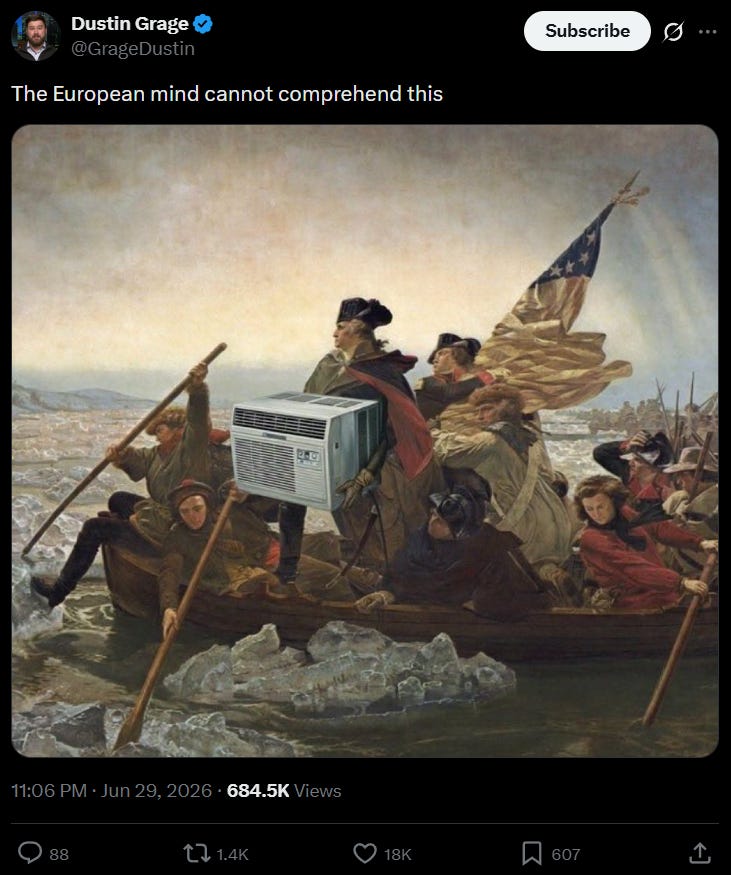
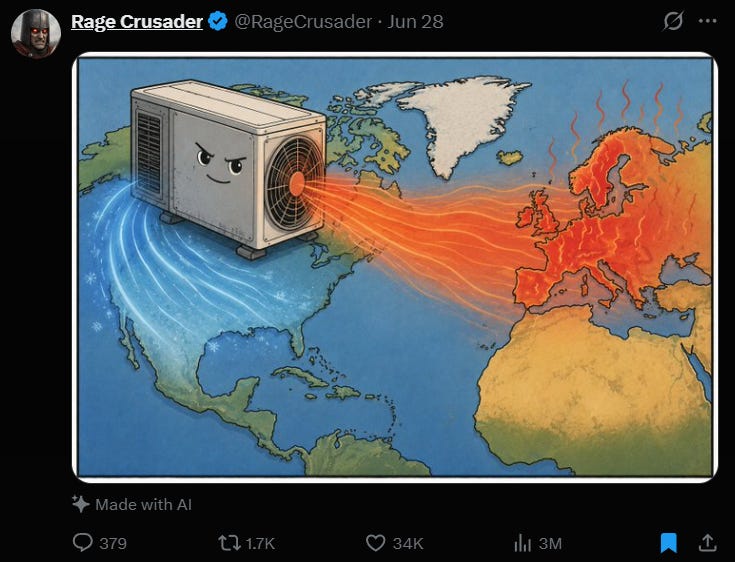
> Ghost of Arthur Powell mocks Europe’s rejection of air conditioning as a failure of a civilizational shit-test.
Lee Kuan Yew understood the detriments of the heat. Singapore only exists because of A/C. Whilst the modern world persists we can and should take advantage of technology we have to make it more habitable. The fact this is now an ideological battleground in Europe is quite depressing. If we take the climate alarmists at their word then this will only become more common, which means we will need to deal with it. Like the cowards that they all are none will propose nuking China or India to address the real villains of carbon output, instead they will continue to destroy their own societies. The death drive of Europe seems absolutely out of control at times like this, the revolution might genuinely have to start with political action that enables Europeans to live normally, the best part is that if it’s “only two weeks of the year” they need the A/C then this is an even easier thing to solve. Right now it’s a continent repeatedly punching itself in the face whilst looking for a gold star whilst the rest of the world looks on with bemused concern.
> Dr. Monzo traces the convergence of the LDS Church’s need to baptize the dead, the CIA’s need to surveil, and Oracle’s database breakthroughs that birthed modern big data.
The convergence of these three institutions, CIA, LDS, and Oracle, seems like it would point to a backroom conspiracy. There may even be one, but the emergent dynamic had far more important consequences than any caffeine-free cabal meeting would have.
Oracle sat at the technical center of two huge identity-record cultures: the national-security state and the LDS genealogical bureaucracy. Mormon talent helped Oracle because Mormons understood the use case intuitively, and Oracle helped LDS institutions because relational databases were ideal for genealogy and membership-scale recordkeeping. The shared interest of these three organizations led each to develop direct relationships with the others, from which the relational database emerged.
And the 🏆Read of the Week🏆 award goes to…
> DataRepublican turns her gimlet eye toward the Bible thumping Never-Trumping David French. Here she maps his selective charity toward progressives, which seems to align suspiciously with the aims of his very secular funders. A good case study in how Lefty institutions capture moderates who are predisposed to police the right and launder the left’s propaganda.
Bluntly, French has made himself incurious about the one question that would unravel his story: why every theological conclusion he reaches happens to be the one the $33 million ecosystem needs him to reach. The institutions just needed to reward the version of him that was already emerging.
📜Lit of the Week📜
> Millennial Woes reviews Citizen Vigilante and finds it lacking, but steps back to appreciate the genre as a healthy pressure release for a society frustrated by a failing justice system.
The genre is inherently poised against liberals. It takes as a given that the civilised West is too weak on crime, that bad people do bad because they are bad and therefore the only solution is to meet violent wrong with violent right. When evil outwits lawful good, chaotic good must be allowed to intercede.
> Semmelweis thinks oft-maligned genre fiction can transcend its genre and prove superior to structureless literary fiction, which often sacrifices the foundation of plot for ideological, narcissistic meandering.
Literature began as the telling of stories, and in the beginning of Western literature, everything is genre fiction. The Iliad, Odyssey and Aeneid? Fantasy, or perhaps Action/Adventure. When men sat around the fire at night, they did not tell stories about their feelings. This isn’t to say feelings are unimportant or unworthy of treatment in literature. The great examples of genre fiction are also examples of great literature—even greater, I would argue, than those books which are simply called “literary” because they have no other features.
> Librarian of Celaeno reads Nolan’s upcoming Odyssey adaptation as a metatextual post-woke horror film.
Notice the constant dripping of information about the cast and plot, the trailers that show bits and pieces of the narrative and cinematography, the dialogue showcased to give an impression of what to expect. It all builds to something: this is going to be utter woke crap, which you can be as certain of as Michael Myers is going to murder some teens in his next outing. The fun comes from wondering when all the tropes will show up.
> Tortuga Media boys Daniel M. Bensen and The 13th Grade have a new podcast. Here they review Cairo Smith’s Scenebux.
Ben Etxina is 25 in 2025, a cusper born between “Millennial dorks” and “porn-fried Zoomers.” A programmer who’s allergic to screens, he lives as the kept boy of his immigration lawyer girlfriend, writing erotica for middle-aged women. From this pad, he launches a picaresque globe-spanning bender, both fleeing and pursuing a somewhat fictionalized billionaire and his shadowy “scenebux.”
🐦Tweets of the Week🐦
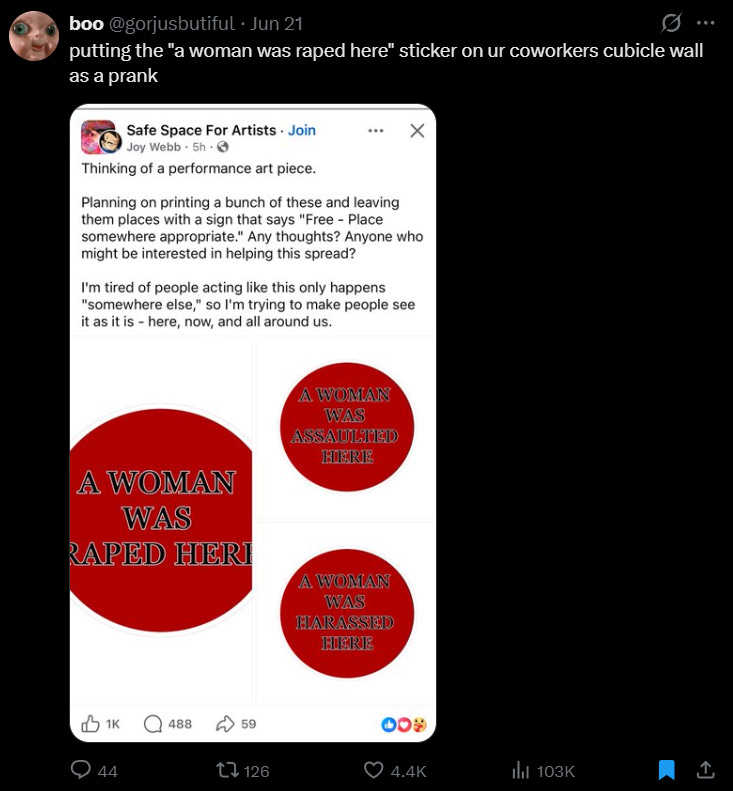


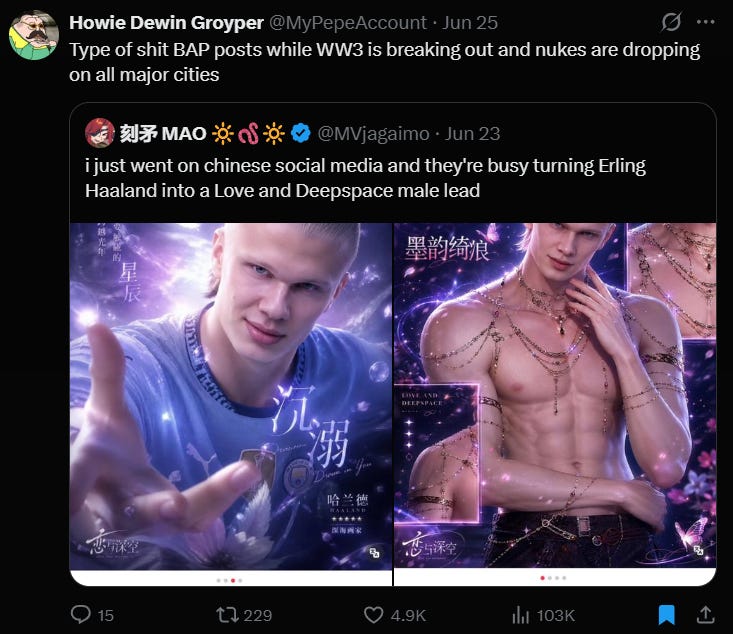




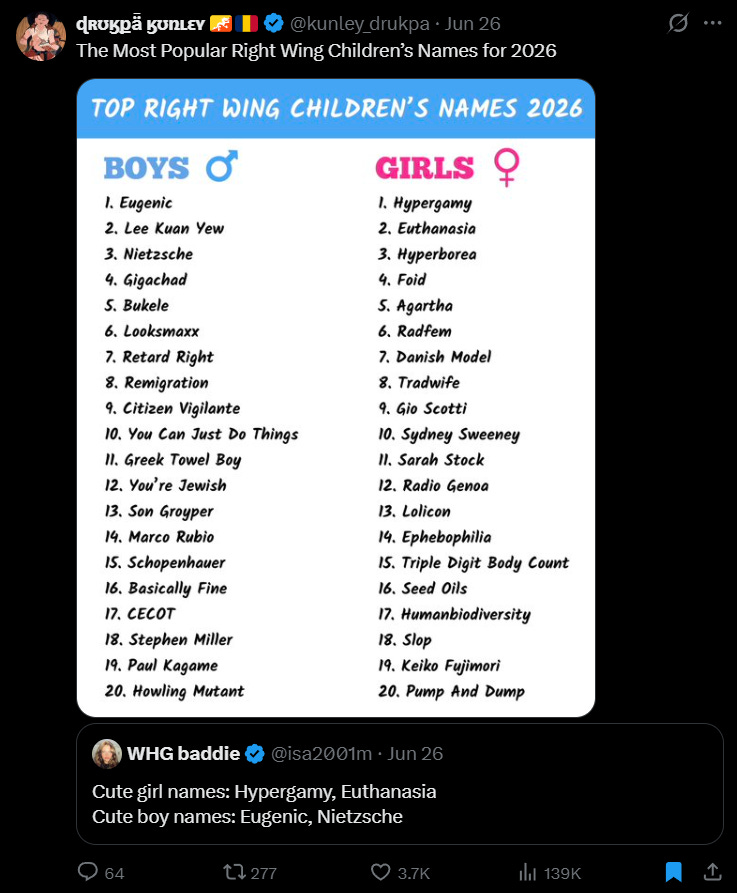





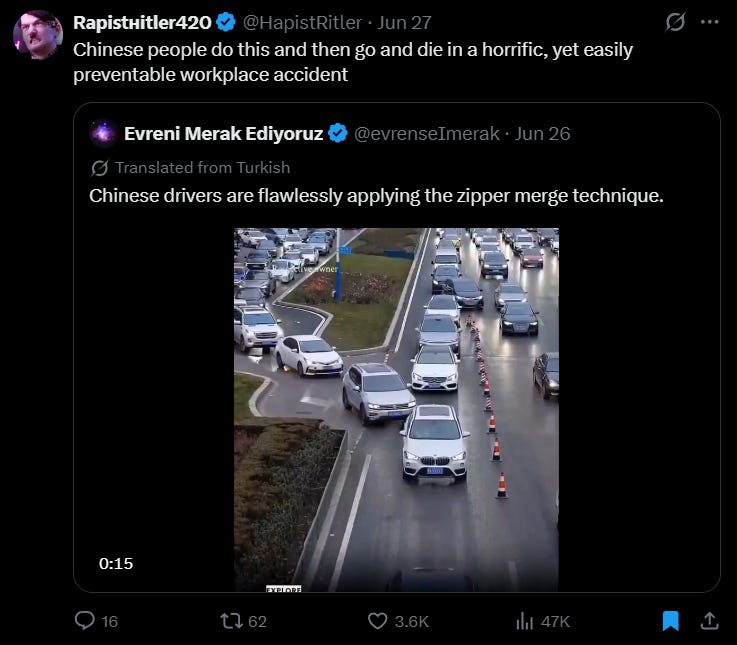


















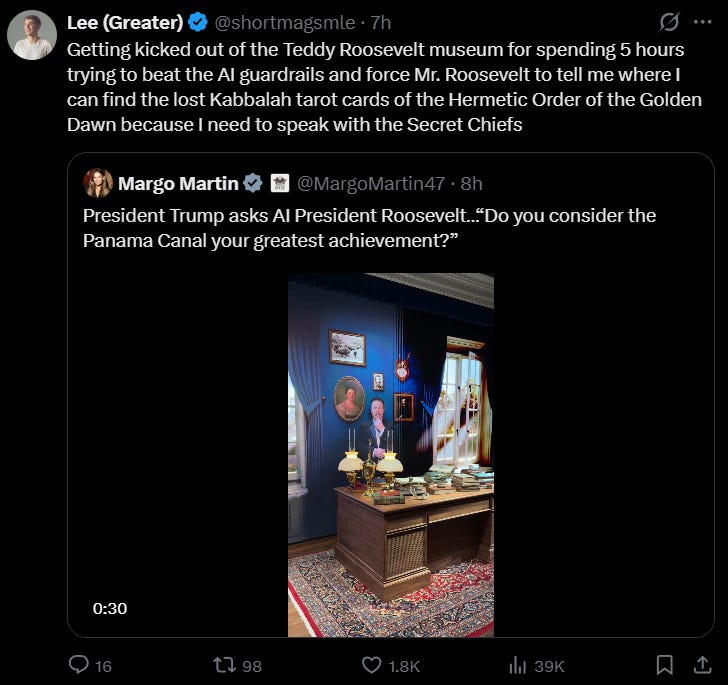



And the 🏆Tweet of the Week🏆 awards go to…

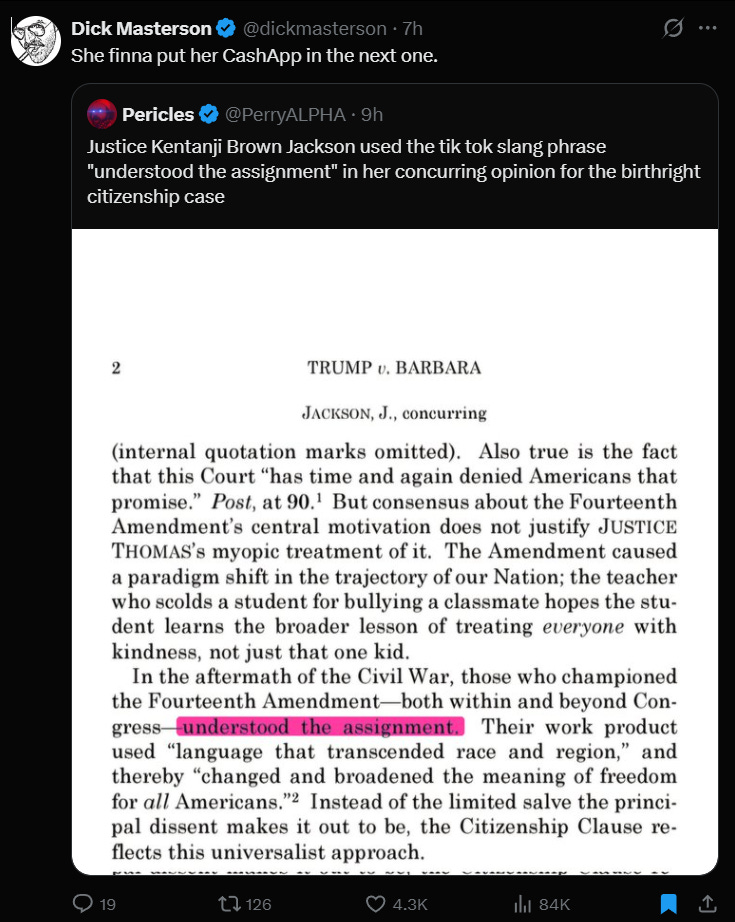
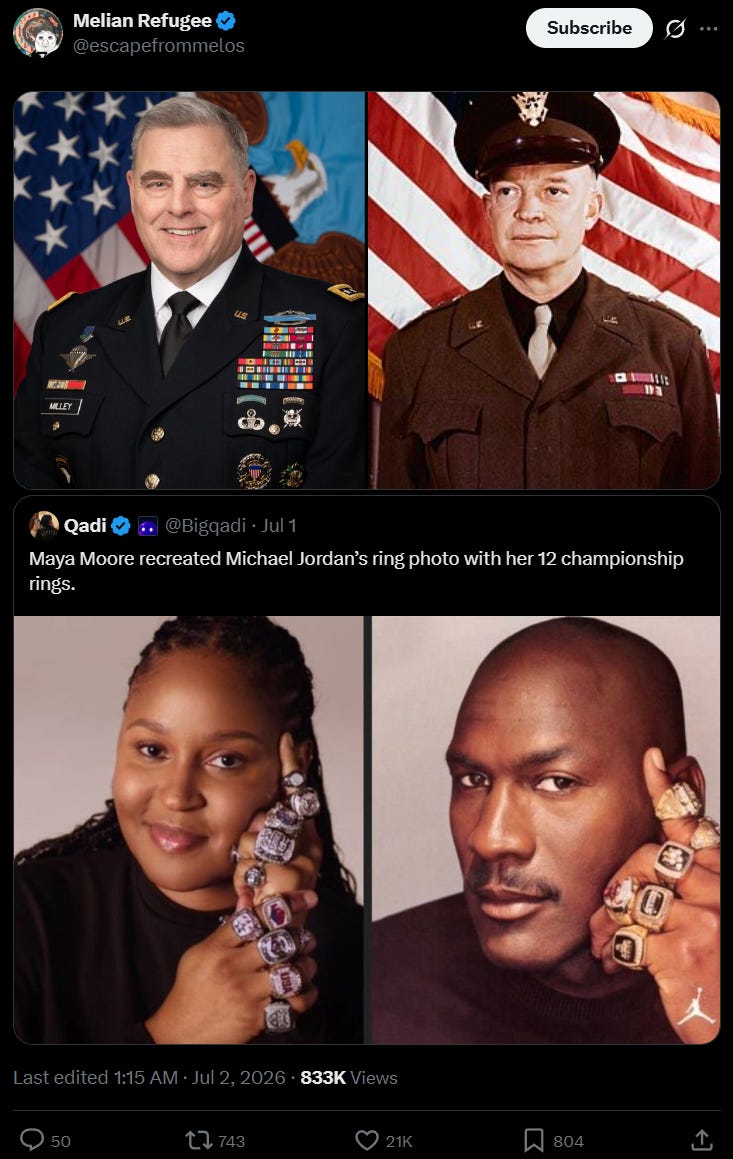
There you have it, folks. Another week in the bag. If you enjoyed yourself, please smash that like button so the Substack algorithm knows to spread it around.
As always, we are publishing All the Shit that’s Fit to Poast. Follow us on Twitter and Substack Notes for lots of other premium banter between issues that you won’t see here. Also, you can now get a paid subscription for full access to the NRP archives, plus a monthly subscribers-only issue.
"Cyberpunk’s never going to happen."
It's already happened. As William Gibson said, "the future is already here, it's just unevenly distributed."
In CP the "downtrodden underclass" has no agency or hope, they just exist to consume and trudge through their day. Just like now.
The protagonists in CP are usually the high function people who rise up through muck with skill, luck, and ruthlessness. Just like now.
The main difference between CP and current_year is that CP is far more utopian than reality. In CP the government has little power, as it is diffused between gov and the major corporations who are semi-sovereign. None of them give a shit about the "downtrodden underclass" except as units of production and consumption; they certainly don't care what the peasants think, say, or feel. They also don't actively try to genocide those people, as again, they simply don't care about them. In CP but not reality, super-science is still a thing. Corps aren't spending billions to "invent" an iphone with a different color scheme, they are spending billions to do raw science then finding applications later. Often horrifying applications, but science is advancing by leaps and bounds.
When I first read William Gibson's "Sprawl" series back in the 90s I thought it was a worst-case scenario of the future. I now realize it was the best-case scenario.
Unhinged, dysgenic discourse. You can't have saddle bags without hip dips, and saddle bags are a prime indicator of reproductive fitness. What next for these moids, aggrieved bleating about her uterine pouch?